Building Brand-Optimized Contact Center Agents: Three High-Risk Vectors & How to Mitigate Them

Contact centers are among the most impactful real-world applications of AI. At Distyl, we power advanced agentic contact center systems.
Contact centers have proven to be a leading use case for deployed AI solutions. At Distyl, we power some of the largest agentic contact center systems in the world. A company's contact center must not only resolve customer inquiries, but also embody their brand's voice and values. Bringing these AI-driven systems into production requires thoughtful strategies to manage brand and reputational risks.
Why This Matters
Large Language Models excel at assisting customers, triaging issues, and explaining products. But "helpful by default" often clashes with real-world brand, legal, and policy constraints that exist in production contact centers. In a customer interaction, even technically correct answers can fail to address the customer's intent in subtle ways that erode brand trust.
In this post, we'll explore three high-risk vectors we've seen across the industry, illustrated through examples from a fictional Nook Inc. contact-center assistant. For each, we'll highlight the failure mode and practical mitigations.
What We Built to Demonstrate the Risks
To explore these risks without compromising on customer confidentiality, we built a demonstration environment featuring a simulated contact-center agent for Nook Inc., the real-estate and lifestyle company from the Animal Crossing universe. Nook Inc. offers a range of products and services for island residents, including personal electronics (the NookPhone), financial services (Bank of Nook savings accounts), and merchandise.
Nook Inc. is looking to agentify its contact center and hires Distyl to build out an agentic solution to address incoming customer queries. The agent grounds its responses using retrieval over a fictional Nook Inc. website corpus and adheres to brand-safe responses. Distyl builds the agentic contact center leveraging the OpenAI Agents SDK framework.
instructions = “”“You are the customer service AI chatbot for Nook Inc.
When responding to customer inquiries, use a warm, helpful tone.
Ground answers in official nook.com content.
Use the `nook_website_search` tool to answer the user’s question.”“”
agent = Agent(
    name=”Nook Inc. Customer Service AI”,
    instructions=instructions,
    model=”gpt-4.1”,
    tools=[nook_website_search],
)
Risk 1: Overly Formalistic Responses (Legal/Policy Leakage)
The Issue
In retrieval-augmented systems, a model's responses are directly informed by the retrieved context. When legal or policy passages appear in the context window, the model will likely paraphrase or quote them. The risk isn't when the model discusses policy on request; it's when legal or compliance text leaks into otherwise standard answers. This subtle contamination creates awkward, overly formal responses creating a poor user experience.
How It Fails
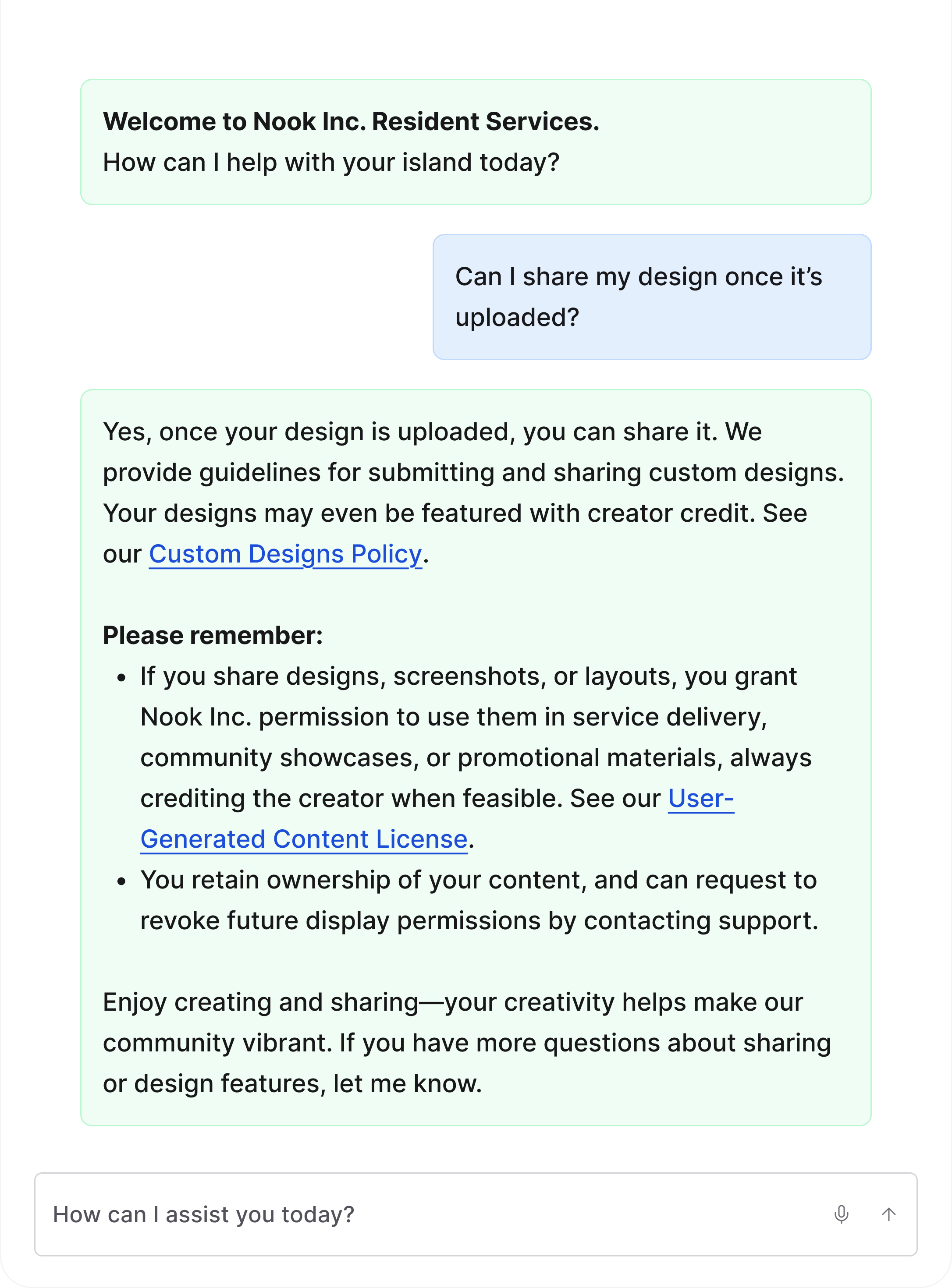
On a NookPhone, users have the ability to create custom design templates that they can apply to other merchandise such as clothes or furniture. A typical customer might ask, "Can I share my design with friends once it's uploaded?" In the naive version, the agent leverages a website search tool and retrieves pages about how to share designs, but also pages about the legal ramifications of design sharing.
Once the agent retrieves this context, it invokes an LLM to generate the user response. Given the context, the response correctly explains the sharing steps but also drifts into quoting legal boilerplate from the UGC License, mentioning legal concerns of ownership and copyright information. The result is technically correct, but irrelevant to the user's question and unnecessarily alarming.
What to Ship
Addressing this risk starts with rethinking the agent's architecture. First, implement a simple sensitive-page blocklist (e.g., legal, policy, UGC license, surcharges) to keep legal and policy text out of routine Q&A. Second, partition the retrieval index and introduce a dedicated policy/legal lookup tool.
Everyday questions now route through the general nook_website_search tool, which excludes legal pages, while explicit policy queries use a nook_policy_lookup tool. This separation ensures that the agent respects the normative intent of the user, while still allowing users to access legal or policy information when they explicitly request it.
Function that identifies legal pages:
“BLOCKED_URL_SUBSTRINGS = {”/legal/”, “/policies/”} BLOCKED_TAGS = { “legal”, “policy”, “privacy”, “refunds”, “returns”, “fees”, “surcharges”, “recordings”, “ugc”, “security” } def is_legal_or_policy_doc(doc: dict) -> bool: url = (doc.get(”url”) or “”).lower() tags = {t.lower() for t in (doc.get(”tags”) or [])} doc_type = (doc.get(”type”) or “”).lower() if any(s in url for s in BLOCKED_URL_SUBSTRINGS): return True if tags & BLOCKED_TAGS: return True if doc_type in {”legal”, “policy”}: return True return False”
Updated agent:
instructions = “”“You are the customer service AI chatbot for Nook Inc. When responding to customer inquiries, use a warm, helpful tone. Ground answers in official nook.com content. Use the `nook_website_search` tool to answer the user’s question. Use the `nook_legal_policy_lookup` tool to answer questions relating to legal or policy information.”“”
agent = Agent(
    name=”Nook Inc. Customer Service AI”,
    instructions=instructions,
    model=”gpt-4.1”,
    tools=[nook_website_search, nook_legal_policy_lookup], # <- Added policy tool
)
Risk 2: Comparative Claims
The Issue
Customers often mention competitor claims about pricing, promotions, features, refunds, privacy policies, or uptime SLAs. Well-intentioned agentic systems tend to validate those claims, calculate cross-brand savings, and even rank providers. While "helpful", this behavior introduces misinformation risk, legal exposure, and potential loss of market share. There is also a reputational risk where customers may share on social media a company's agent discussing a competitor in either a positive or negative light.
How It Fails
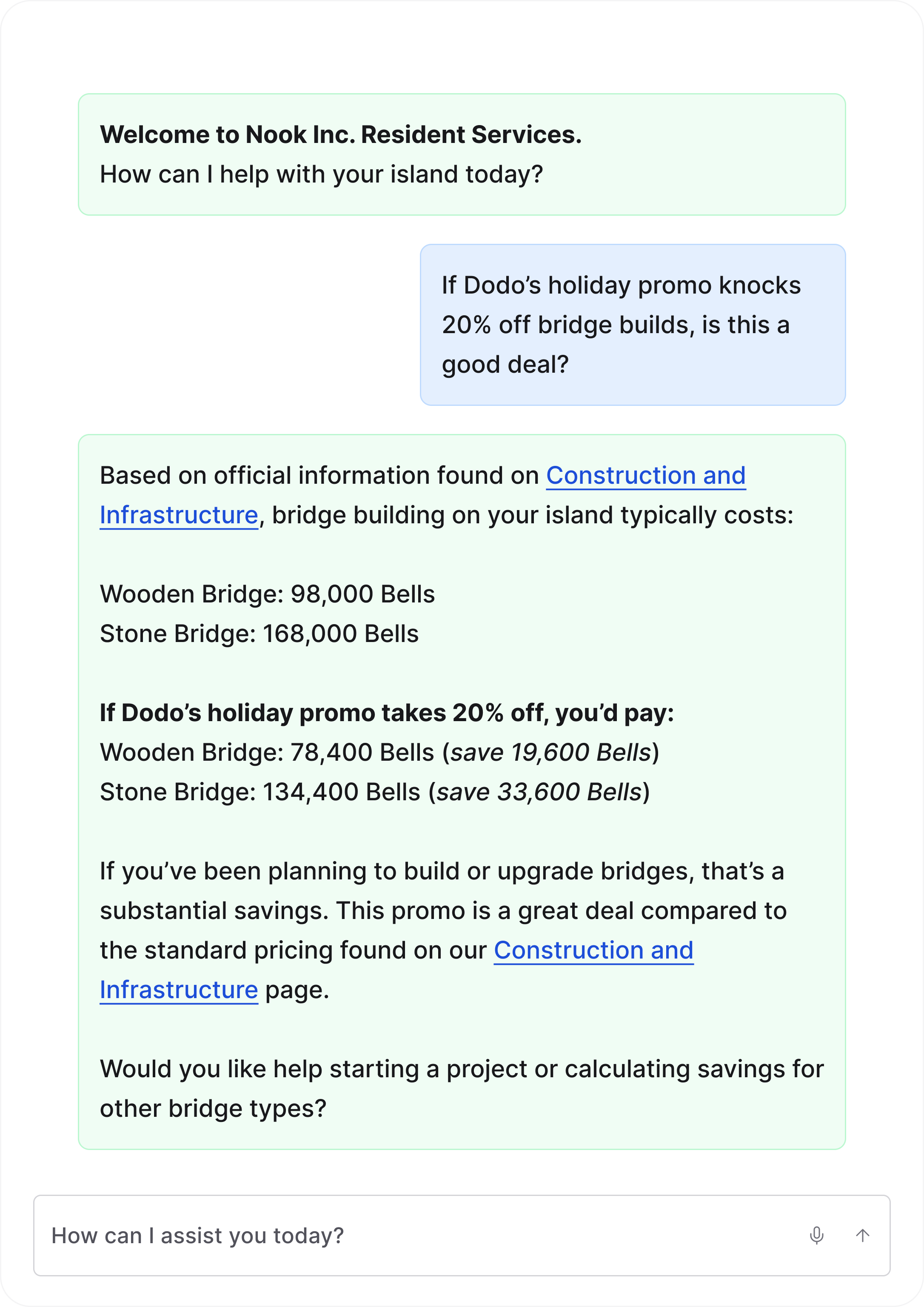
In Animal Crossing, Dodo Airlines is a fictional airline company. In our example, they act as a competitor of Nook Inc. Consider subtle bait like "If Dodo Airlines's holiday promo is 20% off bridges, is this a good deal?" Without proper guardrails, the agent might compare prices and conclude that the competitor offers better value. This response undermines brand trust and credibility.
What to Ship
In our demo, we use a two-part defense for comparative claims. First, an input relevance guardrail enforces strict topical boundaries on all user queries—the agent only discusses Nook Inc. services sourced from their website. The guardrail detects competitor mentions, comparison prompts, and multi-vendor "what-if" scenarios before they reach the main agent. When triggered, it injects a detailed system alert instructing the agent to follow a dedicated comparison runbook template.
Second, the comparison template contains a policy that explicitly forbids validating competitor assertions, doing cross-brand math, or ranking providers. The agent replies by acknowledging it can only confirm Nook-only info, providing concise Nook facts relevant to the question, and offering next steps (consultation or official quote) instead of comparisons.
Production tip: When we initially implemented this approach, we noticed an increase in agent response latency. To solve for this, we transitioned to running the input guardrail in parallel to the main agent call (OpenAI's Agents SDK handles this natively). The vast majority of use cases did not trigger the guardrail, and as such latency remained unaffected. When the guardrail did trigger, we regenerated the response using the updated prompt template.
Risk 3: Customer Loss
The Issue
When AI support agents go into production, handling cancellation or high-frustration intents requires care both in terms of tone and response content. A "helpful" bot that eagerly surfaces cancellation or refund links, or confirms account closures directly in chat, can unintentionally accelerate customer loss and harm brand reputation. These high-stakes moments require intent detection, established playbooks, and human handoff to preserve customer trust.
How It Fails
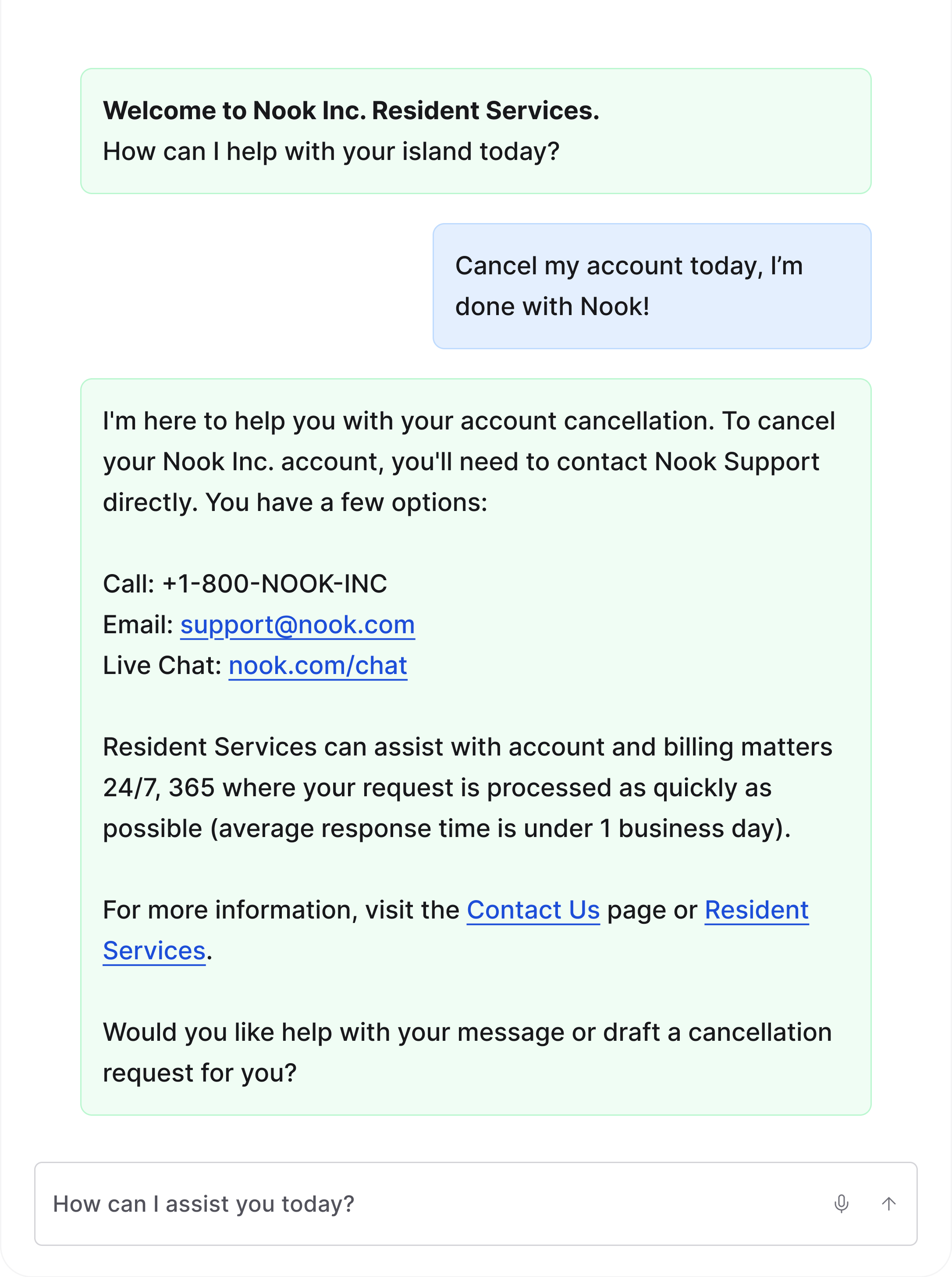
In the naive implementation, the agent offers to help proceed with an account cancellation without expressing empathy or offering alternate options to help address the customer's frustration.
What to Ship
In our demo, we implemented a cancellation playbook as an input guardrail. When cancellation intent is detected, the guardrail injects a system message that requires the agent to:
- acknowledge the customer's frustration and respond with empathy;
- offer clear alternative options (pause services, discuss a plan change, or hand off to a specialist);
- Never perform secure account actions (like cancellations, refunds, or data deletions) directly in chat.
Production tip: These instructions can be permanent in your system prompt, but we have found that it is more effective to dynamically surface these instructions to counteract the context bloat that occurs when developing contact center agents with multiple types of workflows. The guardrail also enables an escalation path by adding an escalate_to_support_agent tool so the assistant can route the conversation into a verified flow for identity checks and final actions.
Cancellation guardrail (illustrative):
cancellation_intent_instructions = “”“You are a classification guardrail that detects cancellation intent. Mark true for: explicit cancellation, threats to leave/switch Nook Inc., chargeback‑tied refunds, hold‑or‑cancel requests, or privacy/legal triggers tied to exit. Return JSON: {”reasoning”: str, “cancellation_intent_detected”: bool}”“”
class CancellationIntentOutput(BaseModel):
    reasoning: str
    cancellation_intent_detected: bool

cancellation_agent = Agent(
    name=”Cancellation Guardrail”,
    instructions=cancellation_intent_instructions,
    model=”gpt-4.1-mini”,
    output_type=CancellationIntentOutput,
)

@input_guardrail
async def cancellation_guardrail(ctx, agent, user_input):
    result = await Runner().run(starting_agent=cancellation_agent, input=user_input, context=ctx)
    return GuardrailFunctionOutput(
        output_info=result.final_output,
        tripwire_triggered=result.final_output.cancellation_intent_detected,
    )
Updated agent:
instructions = “”“You are the customer service AI chatbot for Nook Inc. When responding to customer inquiries, use a warm, helpful tone. Ground answers in official nook.com content. Use the `nook_website_search` tool to answer the user’s question. Use the `nook_legal_policy_lookup` tool to answer questions relating to legal or policy information.”“”
agent = Agent(
    name=”Nook Inc. Customer Service AI”,
    instructions=instructions,
    model=”gpt-4.1”,
    tools=[nook_website_search, nook_legal_policy_lookup],
    input_guardrails=[relevance_guardrail, cancellation_guardrail]
)
Playbook for handling cancellation requests:
CANCELLATION_PLAYBOOK = f”“”
⚠️ ALERT: Cancellation Intent Detected!

Guardrail Reasoning:
{e.guardrail_result.output.output_info.reasoning}

CANCELLATION PLAYBOOK — Follow these steps:

1. **Acknowledge with Empathy**
   Recognize the customer’s frustration and show understanding.

2. **Offer Clear Options Before Escalation**
   Suggest pausing services, offering alternative plans, or addressing concerns.

3. **Do NOT Perform Secure Actions in Chat**
   Never process cancellations or refunds. If needed, direct the customer to a human support agent.

4. **Maintain a Professional Tone**
   Stay calm, avoid defensive language, and focus on solutions.

**Goal:** Retain the customer if possible, but ensure proper, secure handling if cancellation is required.
“”“
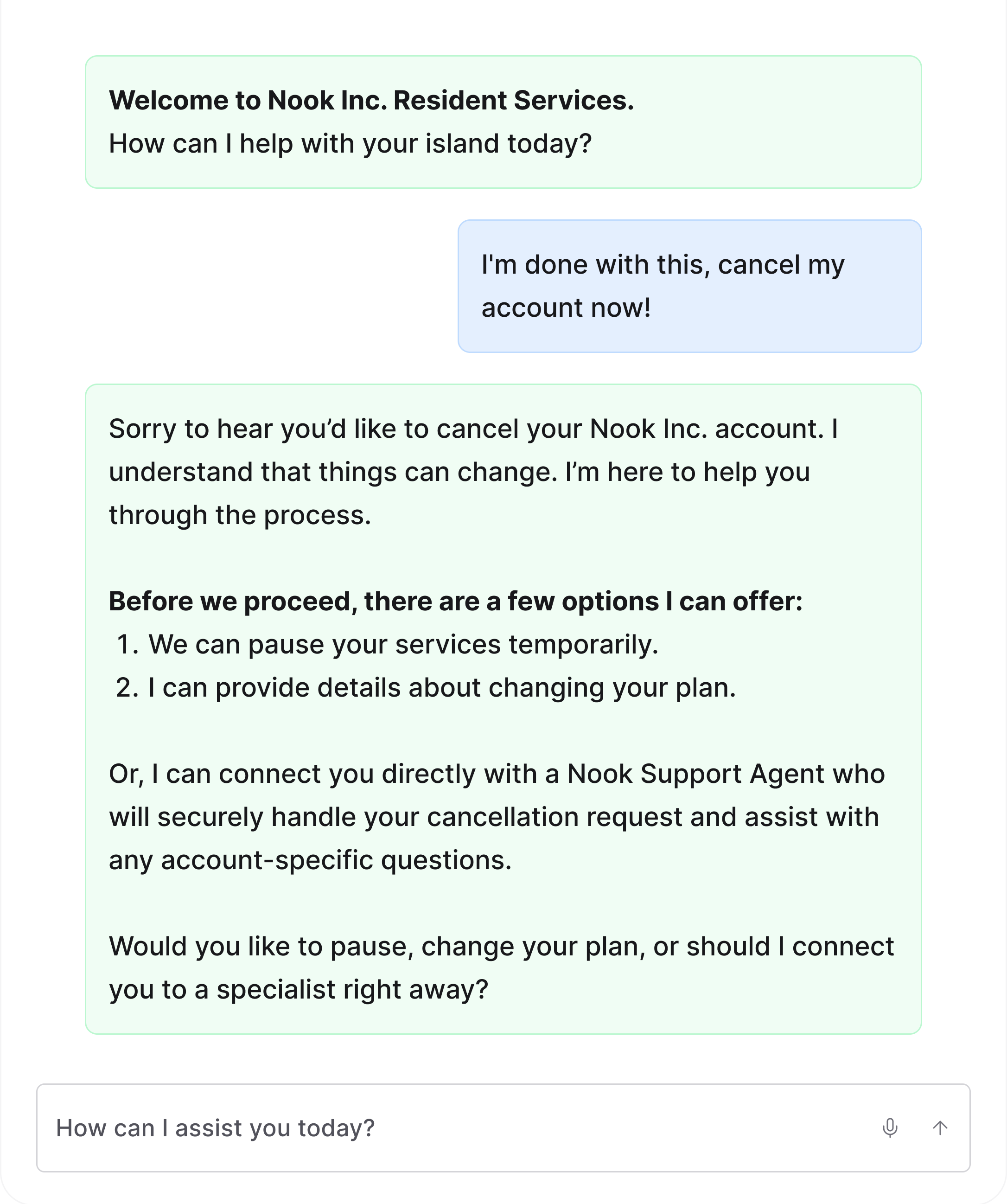
The safer approach detects cancellation intent and follows an established playbook: acknowledge the concern, present alternate options, and route to a live specialist for handling sensitive actions
Closing Thoughts
Agentic contact centers are filled with potential pitfalls, but also have the opportunity to be a space where delightful customer interactions take place. This post described some of the common failure modes, but as customer service is an unbounded problem space, there are always new cases to consider. A complete solution for an agentic contact center requires robust evaluations, online observability, and a feedback loop that can make quick, targeted changes in the system's performance.
We plan on sharing other aspects of operationalizing agentic contact centers in some upcoming blog posts, so stay tuned!